Lainston House, Hampshire: The Dreamiest Winter Wedding And Why You Need Fast Lenses, Not Fairy Lights
Let's get one thing straight: if you've found this post, you're either planning a winter wedding at Lainston House, or you're a photographer about to find out exactly why I now sleep with my fast primes under my pillow. Either way — buckle up, grab a hot chocolate (extra marshmallows, we're celebrating), and let's talk about one of the most ridiculously beautiful venues I've ever had the joy of shooting at.
First, Let's Talk About the Venue, Because Wow
Lainston House is a 17th century Queen Anne manor tucked into 63 acres of Hampshire countryside, just outside Winchester. You roll up the mile-long, lime-tree-lined drive and immediately feel like you've been quietly upgraded to "person who definitely deserves champagne." Heritage brick, ivy creeping up the walls, a crumbling 12th century chapel ruin just sitting there in the grounds like it's no big deal — it's the kind of place where every direction you point a camera looks intentional.
In winter, it gets even better. There's something about frost on those lime trees and warm light spilling out of leaded windows that makes the whole place look like it was built specifically for moody, romantic photography. Which, frankly, I am extremely on board with.
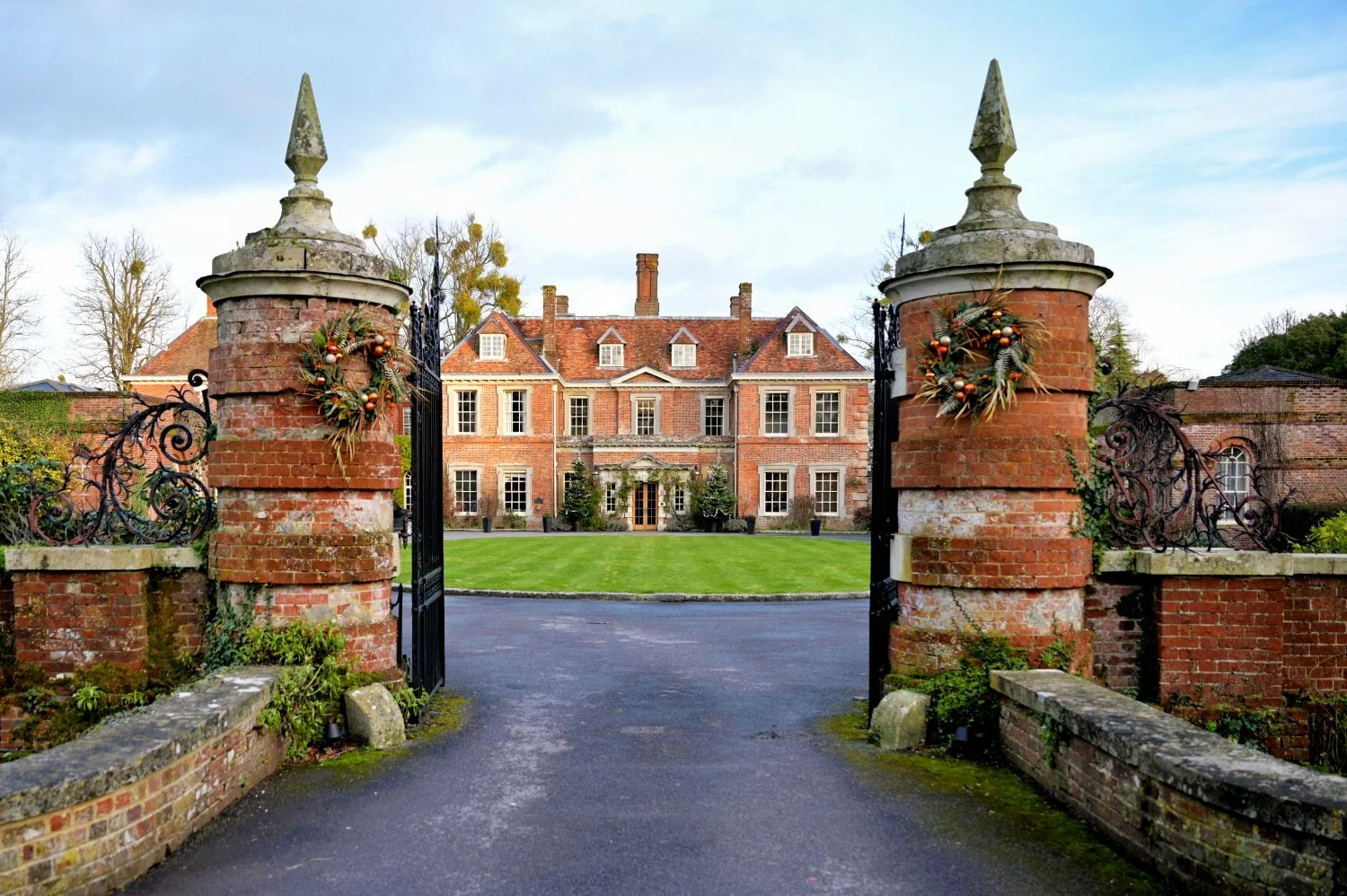
lainston house from the gates during the daylight
Okay, But What's It Actually Like to Photograph in Winter?
Here's the bit nobody tells you when they're swooning over the candlelit-barn aesthetic: winter weddings mean winter light, and winter light has a strict 4pm curfew. You get this gorgeous, soft window in the early afternoon, and then the sun just... clocks off. No warning. No overtime. Gone.
So you need to know your venue's relationship with light, because Lainston House has a few quirks worth planning around:
It's a flame-free venue. No lit candles anywhere — they use flameless alternatives instead, which honestly you can barely tell apart at a glance, but as a photographer it changes how you think about your ambient light sources indoors. You're not getting that gentle candle flicker doing half your lighting job for you.
No fireworks, no confetti cannons. Sparklers are allowed outdoors though, and biodegradable confetti thrown outside is fair game — both of which, if you've ever shot a sparkler exit in near-total darkness, you'll know come with their own delightful exposure chaos.
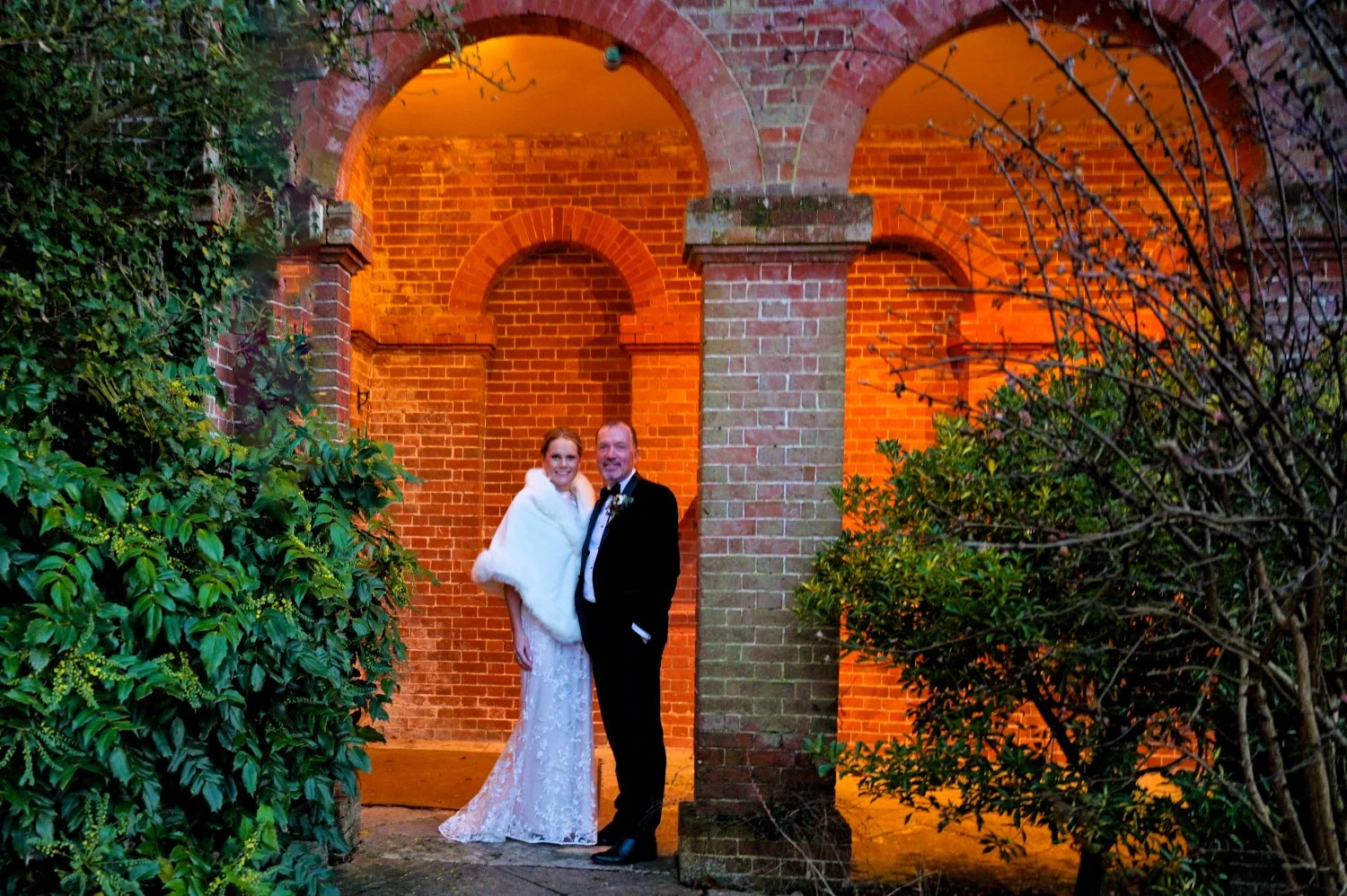
The exterior lighting is genuinely gorgeous. The illuminated brick archways, the lit-up loggias, the warm glow spilling from the house itself onto the terrace — Lainston knows how to light a building for atmosphere. It's not designed for photographers, but it works with you rather than against you, which after a few flame-free, fairy-light-only barns, feels like a small miracle.
The Gear That Actually Earns Its Keep in Low Light
This is where I get a little evangelical, so bear with me. Winter weddings at a venue like this will absolutely expose any gaps in your kit, so here's what's doing the heavy lifting in my bag.
My main body is the Nikon Z6III, with a Z6 riding shotgun as backup. This is not an accident. The Z6III has a quietly brilliant reputation as one of Nikon's best low-light bodies — its partially-stacked sensor and dual base ISO mean files stay clean and usable well past ISO 6400, and plenty of reviewers (myself very much included) have caught themselves shooting at ISO 25,600 without even noticing how dark the room actually was. For a flame-free, lights-down-low evening reception, that headroom is the difference between a useable file and a noisy mess you're fighting in Lightroom at midnight.
My main lenses are the 24-70mm and 70-200mm, which cover the vast majority of a Lainston wedding day — from wide ceremony shots in the Dawley Barn to compressed, dreamy portraits down that mile-long lime tree avenue.
The Viltrox 16mm comes out for tight spaces. Lainston's interiors are gorgeous but not always generous on space — the Ash Room and some of the panelled corners need something wide to do them justice, and 16mm earns its keep there.
And the Laowa 100mm macro handles the fine detail work — rings, invitation stationery, the lace on a veil — all the tiny, easily-missed details that tell just as much of the story as the big romantic shots.
Here's that exterior lighting doing exactly what I mean — warm, atmospheric, and barely needing a flash at all:
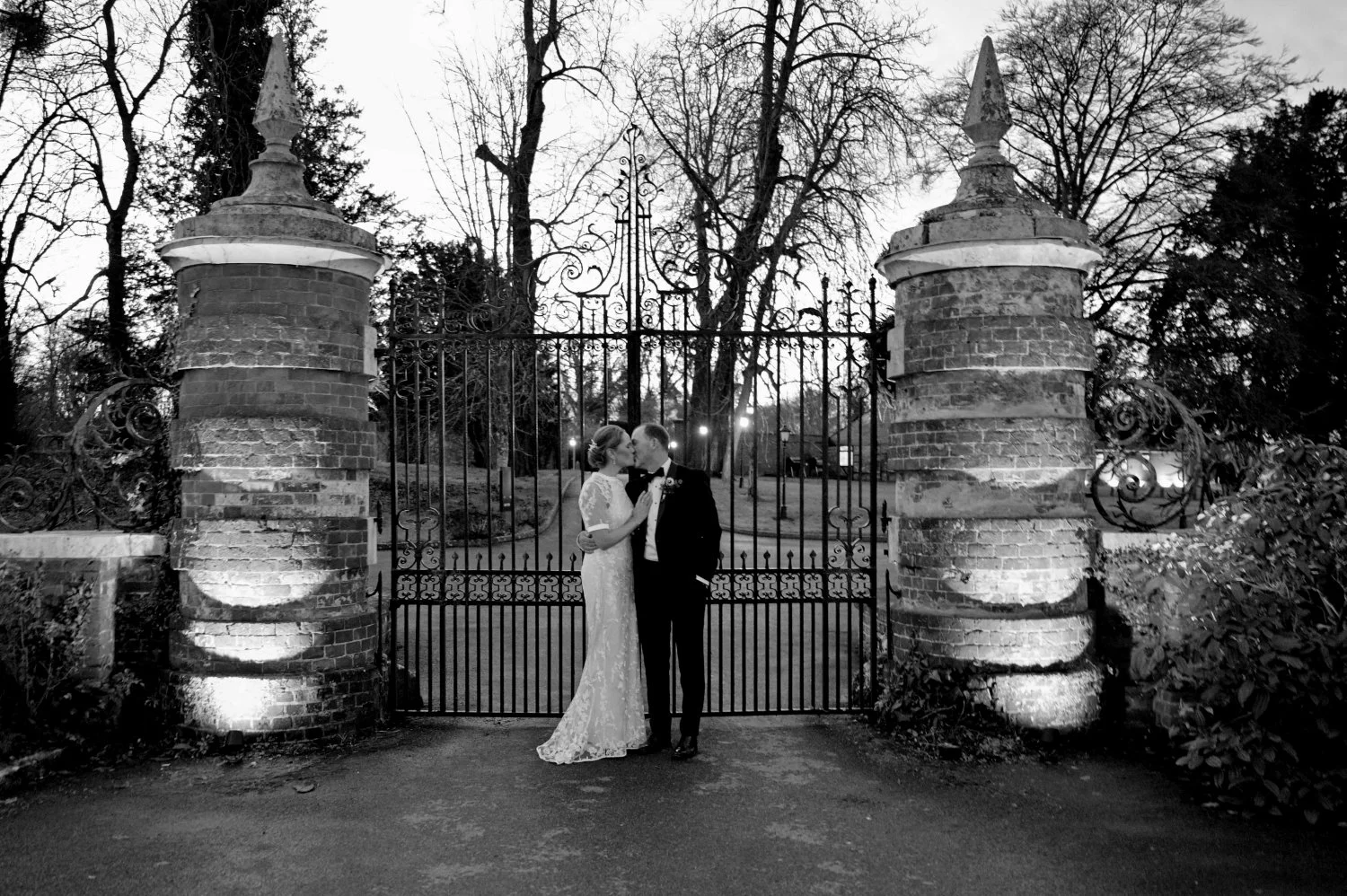
And then there's dusk — that narrow, glorious window where the sky still has a bit of colour left and the venue's lights are just starting to take over. This is the good stuff, the kind of light that makes you sprint (elegantly, in heels, somehow) across a lawn:
So... Should You Get Married Here in Winter?
Yes. A thousand times yes. Lainston House in winter trades summer's golden-hour glow for something a bit more dramatic and a lot more cosy — crackling fires (the flameless kind, but still), mulled wine in the Drawing Room or Dawley Barn, and a building that genuinely looks better wrapped in frost and lamplight than it does under a blazing July sky. It just asks a little more of your photographer's kit bag in return.
Want to see more of what winter weddings here actually look like in practice? Have a browse through my full gallery — there's a bit of everything in there, from Lainston's iron gates at dusk to confetti chaos and the occasional curious cow.
If you're planning your big day at Lainston House and want a photographer who's already made friends with its low light, you know where to find me. ✨